There are times when the universe holds its breath, waiting for a single soul to awaken. For five years—or one thousand seven hundred and fifty-eight days, as the tired voices on the weary television counted—the world had been weeping. The coastal city of Pohang, nested on the eastern shores of the Korean peninsula, had forgotten the sun, its modern towers rising like headstones from the dark water that had claimed so much of the land. The rain was not merely weather; it was the state of being, a constant reminder of a time when the sky had broken, and with it, the hearts of humankind. In this world of perpetual twilight and damp, hope was a foreign currency, hoarded by the old and long since spent by the young, who left for drier, unknown lands.
In a stark, sterile room within a hospital that fought against the encroaching sea, Na-yeon believed in small miracles. An elderly nurse, recalled to service by a world that had consumed its youth, she had learned that all great journeys begin with a single, quiet step. Her journey, for five years, had been to a lone bed by a rain-streaked window.
In the bed, lay a young man—or what was left of one. Though likely only in his twenties, his face held the geography of a much older war. Dark, unruly hair fell across features that were strikingly foreign in this Korean hospital; a face built on sharp, high bones that held the ghost of some long-lost beauty, now rendered a pale and lifeless mask.
Unconscious to the rain, to the years, trapped in an unrelenting dream, his was a story with no title and no words. Yet glimpses of that story were unapologetically engraved across his body, a map of some forgotten, terrible conflict. The sheets lay unnaturally flat where a left leg should have been. The melted remnants of his ear blended into ravenous scars that had healed into permanence—scars that no time could erase.
He indeed was a ship wrecked upon the shore of consciousness, and for five years, Na-yeon had tended to the wreckage, speaking to him in the universal language of kindness. She knew, as all wise souls do, that even when the mind is lost, the heart still listens.
One day, the universe finally exhaled.
From the heart of the great darkness within him, two points of light bloomed. His eyes snapped open. He saw the world as a newborn sees it: a swirl of incomprehensible shapes and sounds. The muffled drone of the old television, the relentless drumming of the rain, the soft, rhythmic beeping of a machine that spoke the language of his own heart. He was a prisoner in his own body, a king with no memory of his kingdom. When he tried to command his hand to move, it only trembled, a disobedient servant. The beeping of the machine quickened, a frantic message from a heart that remembered fear, even if the mind did not.
It was then that the first omen appeared. The door opened softly, and with it came the scent of life. Na-yeon entered, carrying a small bouquet of flowers, a defiant splash of color against the grey world. When she saw his open eyes, the universe seemed to stop. Tears, born not of sorrow but of profound relief, welled in her eyes.
“Oh, my goodness,” she whispered, her voice thick with the language of the heart. “You’re awake! You’re finally awake!”
She spoke to him in the gentle cadence of her Korean tongue, words he could not understand but whose meaning was as clear as any truth. It was the language of a mother, of a protector, of someone who had not given up hope. She pointed to herself, a warm, genuine smile on her face.
“Na-yeon,” she said, her voice a melody. “My name is Na-yeon.”
He stared, a vast, empty ocean in his eyes. There was no recognition, no sign that her words had found a shore to land upon. She saw this, and her heart was filled not with disappointment, but with a deeper compassion.
“Ah,” she sighed, her smile softening. “It’s alright. Rest now. You’re safe.”
The young man learned, in the days that followed, that he was a stranger to himself. When Na-yeon helped him sit, he caught his reflection in a mirror and saw not a face, but a ruin. A visage of melted features, a landscape of scars, an ear that was a testament to some great fire. He saw the empty space beneath the sheet. The sight was a betrayal, a truth so terrible that his soul recoiled. A strangled cry, the first sound he had made, tore from his throat as the machine beside him screamed his terror to the world. And it was Na-yeon who held him, her arms a shield against the horror of his own reality, whispering, “Shhh, it’s alright, you are safe,” until the storm within him quieted into a silent, exhausted tremble.
He learned that kindness had a routine. It was in the fresh flowers that replaced the old, in the warm broth she fed him, in the constant, gentle murmur of her voice that filled the silence of his mind.
And, he learned of the hoodie.
It was a soft, dark greyish garment, comfortable and slightly oversized. When she helped him into it, it felt like a sanctuary. Then she showed him a photograph, worn and cherished, of her family. In it was a teenage boy, her grandson, wearing the very same hoodie. With her gentle eyes and soft hands, she conveyed a story of time and loss. Five years, her five fingers said, pointing to him. You were asleep. He looked at the boy in the photo, then at the fabric he now wore, and for the first time, he felt a connection, a thread of shared existence, however fragile. He clutched the fabric, a silent acknowledgment. He pulled the hood up, and in its concealing shadow, felt a measure of peace.
The days passed, measured only by the wilting and replacement of flowers. Then came the day Na-yeon arrived with a wheelchair. “Perhaps some fresh air?” her smile seemed to say.
Having caringly helped him into the wheelchair, as he was still finding his comfort in it, she slid the balcony doors open, and gently pushed the wheelchair to the very edge of the room, where the door frame was the only thing separating the dry gray of the room, from the soaking gray of the torrential skies. The roar of the rain battering the tired slabs of the balcony floor overpowered all other sounds.
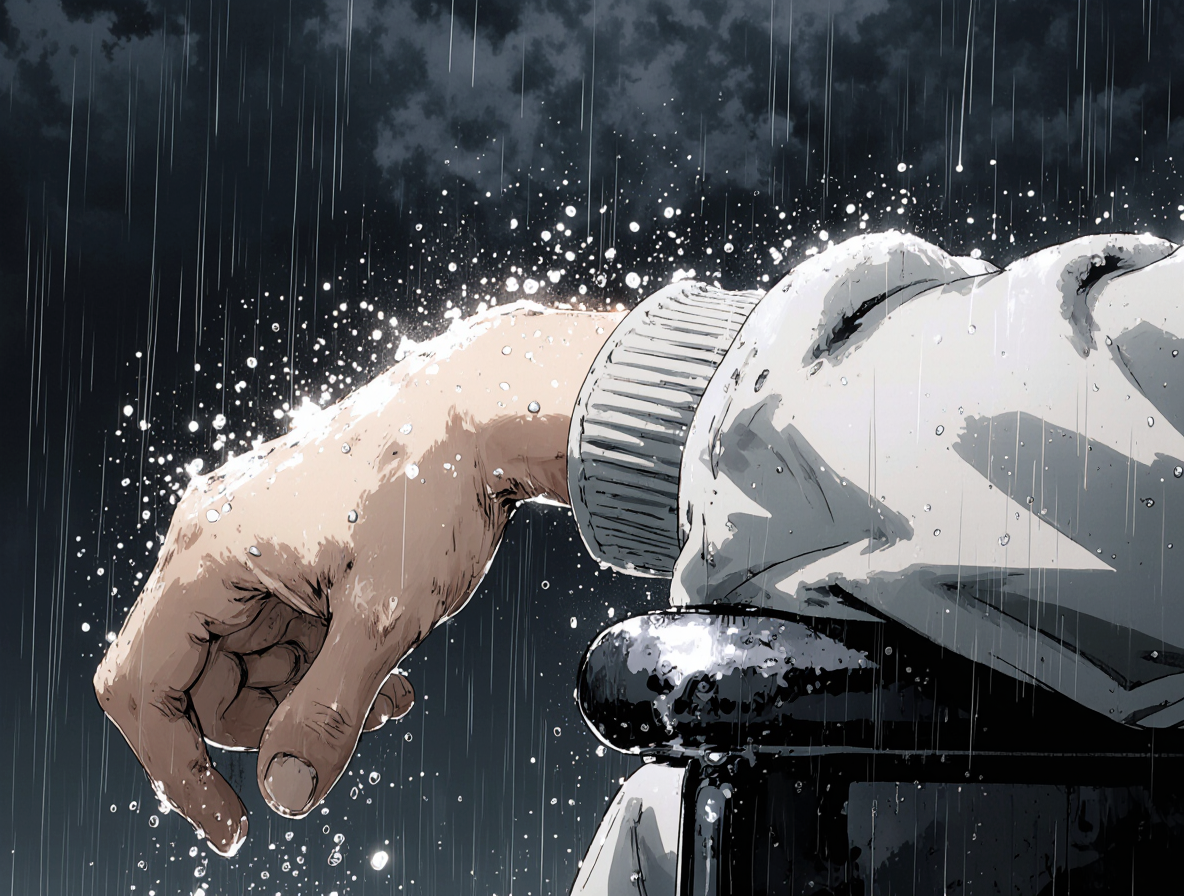
And against that visual, the young man sat still, a silent observer of the world’s endless tears. Then, a new feeling stirred within him, an impulse he did not understand. His hands, weak and trembling, found the wheels of the chair, and he began to push himself forward, the tires tensely overreaching the door frame and taking him towards the rain.
Na-yeon tensed, ready to stop him, but a weak gesture from his hand bade her wait. It was a sign, and she knew one must always heed the signs.
He moved into the downpour. And, the sky felt him with a tremor of stunned recognition. The rain that fell upon him did not fall at all. Each droplet, upon touching his hooded form, shimmered with a pale, inner light, paused its descent, and then began to rise back towards the sky. The damp fabric of his hoodie, the strands of his hair, lifted gently, pulled upwards by an impossible, reversed current. He tilted his head back, his scarred face turned to the heavens, and for a moment, an expression of serene, ancient bliss crossed his features as his mind immersed itself into a trance.
Na-yeon watched, her soul trembling with an awe so profound it bordered on fear. It was a miracle. It was impossible. Her hands on her lips, her eyes stunned in fullness.
A perfect moment of impossible peace such as this one, felt forbidden and out of place in this broken world. And if brokenness was the norm, this moment couldn’t be afforded even a glimmer of hope of lasting any minute longer. And so, in an instant, it was shattered.
A deafening explosion rocked the hospital to its foundations. The building shook, and the balcony groaned, collapsing into the storm below just as Na-yeon, driven by an instinct deeper than thought, lunged forward and pulled his wheelchair back from the precipice.
Chaos erupted. Smoke, alarms, falling debris. Lost, Na-yeon looked at him. And the young man, his face now surprisingly lucid, lifted a hand and pointed down a corridor. It was another sign. She did not question it. She gripped the handles of his chair and ran, pushing him into the heart of the pandemonium, away from the sky and towards a new, unknown destiny.
From outside, beyond the veil of the storm, other eyes watched the destruction. A voice, harsh and disembodied, cut through the chaos, carrying the true meaning of the day’s welcome.
“Shoot at sight!” it commanded. “Spare no munition! He must die!”
The journey had begun.