Category: Season 1

  • Chapter 10: Rhythms of Hope

    Chapter 10: Rhythms of Hope

    The train station was an isolated island of cheer in a sea of grey. Colourful streamers and handmade paper lanterns, defiant against the perpetually overcast sky, flapped in the fresh breeze. The platform was crowded with families, their faces etched with the weariness of the world but their eyes holding a spark of hopeful anticipation. The sound of their chatter and laughter was a foreign music, a forgotten melody.

    As an old train, puffing steam like a tired beast, pulled into the station, Na-yeon felt a faint smile touch her lips. “It seems the festival spirit is strong, even now,” she said.

    “Can’t keep good people down, Ajuemonim!” Min-jun grinned, his own spirits lifted by the vibrant scene. “Seoul, here we come!”

    They joined the friendly surge of people boarding the train, finding a set of facing seats in a bustling carriage. The air inside was warm, filled with the scent of damp coats and the sweet promise of the city. Sujin, Myung-hee, and Na-yeon sat on one side, while Min-jun sat opposite, next to a man with kind, weary eyes who held a small, brightly dressed girl on his lap. The girl, no older than five or six, held a small toy drum.

    Her name was Bo-Ram, and her eyes, bright with a child’s unfiltered curiosity, immediately fixed on Sujin.

    “Mister! Mister!” she chirped, pointing a tiny finger. “What happened to your ear? It looks like a pretty seashell! Does it hear funny songs from the sea?”

    Sujin, who had been gazing out the window, turned, startled. He touched his pearlescent ear self-consciously. “Oh, this old thing?” he said, his smile gentle but shy. “It’s… just a souvenir from a long swim. It hears the wind mostly, and sometimes…” he leaned in conspiratorially, “…it whispers secrets about where the best puddles are for splashing.”

    Bo-Ram giggled. Sujin, feeling a touch exposed, subtly pulled the hood of his grey sweatshirt further up. The girl’s father, Park Min-Su, smiled apologetically. “Forgive her. We’re heading to the festival in Seoul.”

    As the train rattled on, Min-jun and Park Min-Su fell into easy conversation.

    “You have an eye for how things work,” Min-Su observed.

    “Used to,” Min-jun confirmed. “Fast cars, loud engines… a world away now. Now, I just try to keep an old ambulance running. Taking folks to their treatments.”

    “A different kind of race against time, then,” Min-Su said with a soft, sad smile. “I was a sound engineer. Concerts, festivals like this one. My wife…” he paused, glancing at his daughter, “she always said I could hear a pin drop in a hurricane. Bo-Ram has her mother’s spirit for music.”

    The mention of a race against time, of a loved one lost to the world’s sickness, sent a ripple through Min-jun’s memory. For a moment, he was not on the train, but in a quiet room, holding the hand of his girlfriend. He saw her pale, weak face, her loving eyes. He felt the faint, final squeeze of her hand, saw her eyes gently close, and felt her warmth fade, leaving only the cold silence and the steady, indifferent hum of a medical device. He blinked, the rhythmic clatter of the train pulling him back to the present, a shadow of the memory lingering in his eyes.

    “Yeah,” he said, his voice a little thick. “Festivals… they’re for making good memories. Important to have those.”

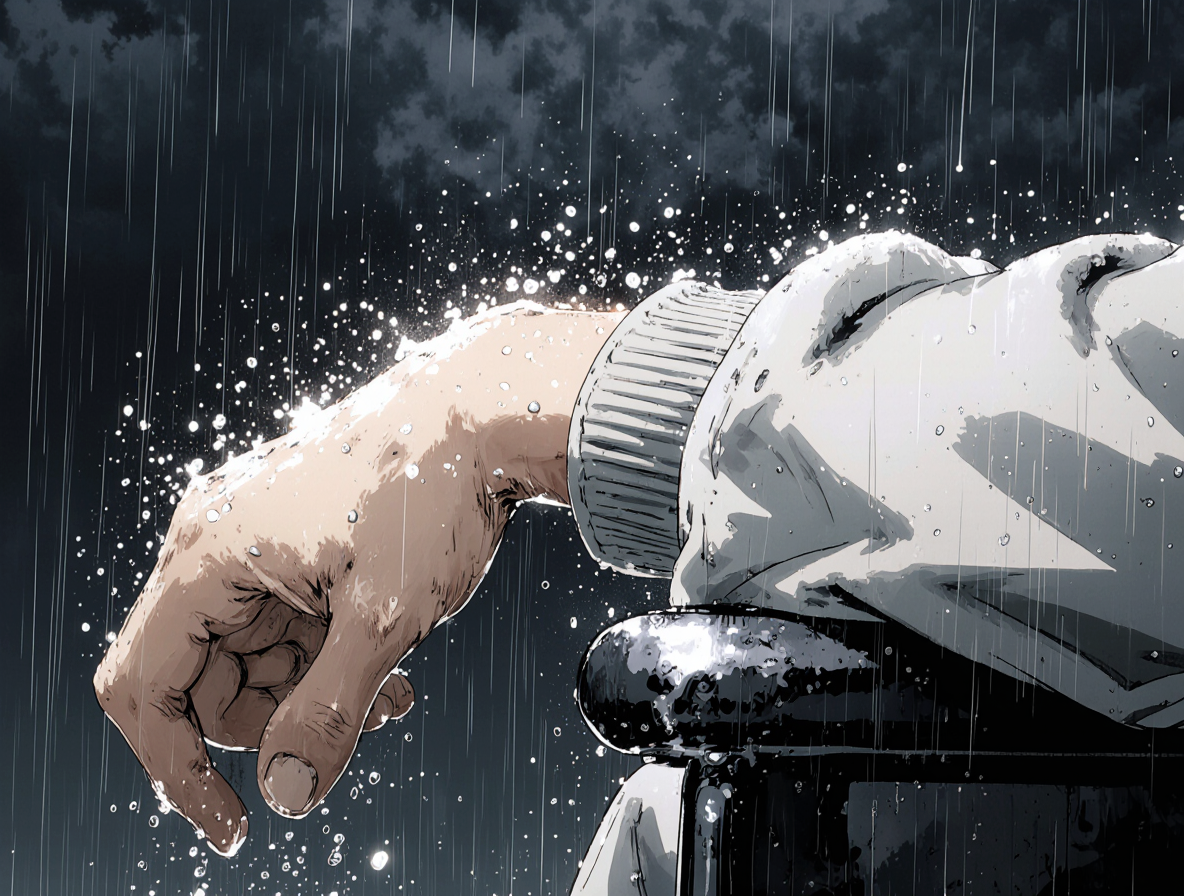
    Sujin was looking out the window again, his hand resting against the cool glass. As the train passed through a sudden, heavy shower, he idly traced a small circle on the inside of the pane. Outside, a cluster of raindrops on the glass began to swirl in a tiny, perfect vortex, momentarily defying gravity before breaking apart.

    Bo-Ram gasped, her eyes wide. “Appa! Halmoni! Look! The rain is dancing! The mister is making the rain dance!”

    Sujin flinched, yanking his hand away from the window as if burned. The effect vanished instantly. Na-yeon, seeing his panicked expression, let out a warm, hearty laugh.

    “Aigoo, Bo-Ram-ah, such an imagination!” she said, patting the girl’s head. “This old train is just rattling us about! Or maybe… maybe the Sky Dragon heard we’re going to the festival and sent his littlest rain-sprites out to play hide-and-seek on the windows!”

    Bo-Ram giggled, distracted, and Sujin offered Na-yeon a small, grateful look.

    Later in the journey, Myung-hee leaned her head back, her eyes closed, her breathing shallow. Sujin looked at her, and for the first time, he saw something new. Around the other passengers, he could perceive a faint, warm aura of light—Bo-Ram’s was particularly bright and playful. But Myung-hee’s aura was dimmer, flickering like a candle in a draught. A concerned understanding dawned on his face.

    He leaned towards her. “You look tired, Myung-hee,” he said softly. “But your spirit… I can see it… it’s still very bright. We’ll get you to Seoul. You’ll see all those lanterns. Just hold on.”

    Myung-hee’s eyes fluttered open, and her weak smile gained a little strength. “Thanks, Sujin,” she whispered. “I’m trying.”

    As they neared Seoul, the festive atmosphere in the carriage grew. Park Min-Su explained that he and his daughter were part of a small percussion troupe, but they were missing a couple of members.

    “A kkwaenggwari, you say?” Min-jun’s eyes lit up at the mention of the small brass gong. “I could make some enthusiastic noise if you need it!”

    Sujin, listening to a nearby passenger play a soft melody on a flute, unconsciously began to drum a steady, powerful rhythm on his knees.

    “My word, young man!” Park Min-Su said, his eyebrows raised in appreciation. “That’s a true heart-beat rhythm! Have you ever played the Buk?”

    He retrieved a small brass gong for Min-jun and a portable barrel drum for Sujin. Min-jun grinned, striking the gong with sharp, lively taps. Sujin ran a hand over the drum’s skin, then began to play. A deep, resonant beat filled their corner of the carriage, a rhythm that was both powerful and soulful. He seemed lost in it, a focused intensity on his face.

    Other passengers turned, smiling, clapping along. From a bag of colourful fabrics, festive attire emerged. Min-jun, laughing, held up a striking turquoise silk robe embroidered with dragons.

    “Sujin! Look at this! It’s perfect! The Dragon King of the Festival!”

    As Sujin considered the robe, a memory bloomed in Na-yeon’s mind. A bright, sunny day at a past festival. Her husband, laughing, as their young son—wearing a familiar greyish hoodie—helped his own little boy fly a dragon-shaped kite. Her daughter-in-law, smiling radiantly beside them. A perfect, sun-drenched moment of joy.

    She returned to the present, a single tear escaping, which she wiped away with a soft, bittersweet smile. She caught Sujin’s eye and nodded. “It would suit you, Sujin. A strong look for a strong heart.”

    Soon, they were all transformed. Sujin, holding the Buk drum, wore the dragon robe. Min-jun, his kkwaenggwari in hand, looked ready to lead a parade. Na-yeon and Myung-Hee, in beautiful, colourful hanboks, held elegant fans.

    “Wonderful!” Park Min-Su beamed. “The hospital Myung-Hee needs is just beyond the main festival route. We’ll have to pass through the crowds anyway, might as well do it with music in our hearts and a bit of light in our hands, eh?”

    They looked at each other, a small band of survivors, now a troupe of hopeful performers. The train rattled on, carrying them towards the city, towards the promise of healing, towards a festival of light in a world drowning in shadow.

  • Chapter 9: Scars of the Sky

    Chapter 9: Scars of the Sky

    In the quiet hours before dawn, when the world is at its most honest, Na-yeon stood alone on the farmhouse porch. The gentle, steady rain drummed a familiar rhythm on the roof, a sound that had become the world’s heartbeat. Inside, near the dying embers of the hearth, her companions slept, but sleep offered her no refuge. Her heart ached with a confusion so profound it had become a physical weight, and a deep, cold fear coiled in her soul.

    “Forgive me, Ajuemonim.” The farmer’s voice was soft beside her. He had emerged from the house as quietly as a ghost, holding two steaming mugs. “Does my humble home keep your sleep away? Or perhaps the night itself weighs heavy?”

    Na-yeon startled, accepting the mug with a trembling hand. “Oh, no, my friend. Your generosity… it is humbling. Forgive an old woman. The mind races…”

    “Restlessness,” he said, leaning against the porch rail beside her.

    “I don’t know many people who have kept their peace after the… “ Na-yeon responded absent mindedly. I… I… the memories… They keep coming back…

    The world changed forever… ” He stared out into the darkness, but his eyes were seeing a different time. “I was in Daejeon. High up in a glass tower, staring at a screen. Then… a sound. A deep, resonant hum, vibrating through the building, through your very bones. And the screens just… died. All of them. Black.”

    He paused, and Na-yeon could almost see the memory playing out behind his eyes.

    “The silence lasted only a heartbeat. Then someone pointed. Outside.” His voice grew hushed with remembered awe and dawning dread. “The sky… it just… lit up. Colors I’d never seen, dancing like mad ghosts. Beautiful, terrifyingly beautiful. We didn’t know it was a warning… the scream before the strike.”

    He described the sky glitching like a broken screen, of birds falling like stones, of planes tumbling from the heavens like broken toys. He spoke of the chaos, the running, the fires, and the sudden, deathly silence of a world without technology, a world where the only news came from the smoke rising on the horizon.

    “My own son,” the farmer said, his voice thick with a grief that time had not healed, “studying in France. I haven’t heard a word since. Not one.” He sighed, a heavy, weary sound. “They never told us what really happened. But people whisper… desperate whispers in the dark. They say the Devil himself clawed his way up from the depths. That the Sky Fall was his arrival.”

    Na-yeon’s breath caught in her throat. The farmer’s words were not a story; they were a confirmation of the terrible certainty that had taken root in her heart.

    “It was him,” she whispered, her knuckles white around the warm mug. Tears streamed down her face, hot with hatred and terror. “The Evil One. He ripped the sky open… took… everything! My son… my daughter-in-law… my husband… My grandson… vanished…” Her voice broke. She glanced inside at the sleeping form of Sujin, and a new, more terrifying thought seized her. “Dragon King… Yongwang…” She shuddered violently. “But what if it’s just another mask? Another trick? How can such power come from anything good in a world he ruined?”

    The farmer looked at her, his weathered face filled with a deep, sorrowful understanding. “Belief born of terror and loss is a powerful thing, Ajuemonim. This anger, this hatred… they are heavy stones. To survive, we must find a way to let them go. Forgiveness is not for the Devil… but for yourself. To free you from seeing darkness in places where… perhaps… something else resides.”

    Na-yeon shook her head, weeping silently into the rain. “Let go? My friend… my heart… it cannot. But, I feel the confusion you suggest to me so carefully. And what I see, and feel and what i fear… They feel different. They do not feel as one. Maybe…

    As the two soul-scarred elders consoled each other on the weathered porch overlooking the small garden, the sun was piercing through from very low on the horizon. Dawn was in fact, one of the rare moments the sunshine could be felt stronger as it was coming from under the cloud shroud.

    Morning brought a fragile peace. The group awoke to the smell of cooking and the sight of a cozy, book-lined room. On a sturdy shelf stood a collection of beautiful porcelain vases, their celadon greens and whites gleaming softly. Na-yeon’s gaze fell upon one that had been mended with delicate lines of gold.

    “My wife cherished them,” the farmer said, noticing her interest. “She found that one shattered. Sometimes, mending what’s broken makes it hold more stories.”

    “Is it more fragile now?” Na-yeon asked, tracing a golden seam. “Or does the gold make it stronger?”

    The farmer’s expression grew somber. “The gold holds it together beautifully. But porcelain… once it shatters, the memory of the break remains. It might look strong… but handle it without care along those golden lines, and it will likely break again, perhaps even easier than the first time.”

    His words hung in the air, a quiet metaphor for the boy who now stirred by the fire.

    The farmer, ever gracious, suggested they pick vegetables from his garden for breakfast. It was a pocket of surprising life, and for a moment, a simple, happy chatter filled the air.

    As they were all scattered across the garden, picking their designated vegetables, Sujin, seeming to revel in the normalcy of the task, knelt to pick up some carrots. It was an amusing moment, as he couldn’t really remember how to recognise a carrot from above the ground, and so, myung hee who was only a row or so away kept yelling over the greens, attempting to explain how one would go about recognising a carrot’s leaf.

    Indeed, everyone found it amusing, for Min-jun, from much farther away started ‘helping’ too, giving completely opposite instructions to Myung hee, finding great fun in confounding the already baffled Sujin, who still was quite enjoying himself. The soft giggles of elders also added to the fullness of air with sounds of normalcy. Even the sky seemed to be feeling the positivity of these accidental farmers. The rain had almost seized, and the clouds lightened significantly. Almost a normal day. Almost.

    Suddenly and without too loud a reaction, Sujin gasped, stumbling back and clutching his hand.

    Myung-hee was the first to see it—a venomous snake slithering away into the undergrowth. “SNAKE!” she screamed.

    The instant she yelled, the sky above darkened. A jagged fork of lightning flashed down with unnatural speed, striking the spot where the snake had been, incinerating it in a puff of smoke. But Myung-hee was already kneeling beside Sujin, ignoring the belated celestial intervention. Two small puncture marks were visible on the back of his hand. Without a second’s hesitation, she ripped the scarf from her head, revealing her baldness—a stark reminder of her own quiet war—and tightly wrapped the fabric around his forearm. She pressed her mouth to the wound, sucking hard and spitting the venomous blood onto the earth.

    In this moment, as Sujin was fighting with the delirium induced by the poison, he caught glimpse of Myung-hee’s sight, and felt her self-consciousness as she understood his inescapable first look at her hairless head. The look that she was adamant never to allow anyone in her vicinity to punish her with. One of pain, pity and terminality.

    Luckily, that denuding moment didn’t last long and it had dispersed as swiftly as it came about. The others rushed over. The farmer, with the swift competence of a man who lived by the land, gently pulled Myung-hee back and applied a dark, pungent herbal mixture to the bite. Sujin, pale and sweating, leaned against Na-yeon, who held him, stroking his hair as a profound and complicated love warred with the fear in her heart.

    He would live. The intervention of the new found family made sure of that. Even if the sky had failed him. For the darkness has returned to the clouds once more, and the rain poured again. And now, things were back to the actual normal. The new normal. The sad, gloomy and wet one.

    But this incident had repercussions beyond the obvious. It whispered something to Na-yeon’s heart. It showed her that her heart may have already decided what her mind did not yet concede. But the mind now got a new revelation too. He bled, he could die, he is human.

    Some time later, as the shock settled and Sujin regained his composure and strength, the team had gathered around the farmer’s table, intently listening to Myung-hee – the day’s hero – recounting how she had learned the life-saving skill at her orphanage. Her story of a childhood friend, another small hero in a world of forgotten children, hung in the warm air.

    “We look out for each other, right?” she said with a small, determined smile.

    “Exactly!” Min-jun agreed. “And we’re getting you to Seoul! Best doctors are there.”

    “Seoul,” Na-yeon mused, a new thought taking hold. “It must be almost time for Yeon Deung Hoe, the Lotus Lantern Festival. A tradition stretching back a thousand years.”

    Min-jun’s eyes lit up. “The Lantern Festival! They say lighting a lantern illuminates the world, shares wisdom and compassion. Imagine, thousands of lanterns… dragons, phoenixes… floating down the stream. It must be something else.”

    “Lighting the world… with wishes,” Myung-hee whispered, captivated. “Like flowers blooming from the mud. It sounds… hopeful.”

    The farmer, moved by their talk of a city he had long since abandoned, offered to take them to a small, rural train station over the next ridge. “Sometimes a passenger train still runs,” he said. “It will be crowded, but it goes towards Seoul.”

    As they prepared to leave, dressed in simple, clean clothes gifted by their host, Na-yeon watched Sujin pull his familiar grey hoodie on over his new shirt. “This still has meaning for you?” she asked.

    “Yes, Ajuemonim,” he said, touching the worn fabric. “It feels like the first real thing I remember holding. It feels… safe.”

    At the station, they found an unexpected pocket of life. The platform was crowded with families, their faces filled with a determined festivity. Colorful streamers and handmade paper lanterns flapped in the breeze under the perpetually overcast sky.

    They said their farewells to the farmer, their hearts full of a gratitude that words could not express. Sujin was the last. He stepped close and embraced the old man.

    “Ajeossi,” he whispered, his voice calm and kind. “Thank you. But you mustn’t push yourself. Have some rest. Don’t hurry home today. You’ll know when you’re ready to continue what you need to do.”

    The farmer pulled back, puzzled but struck by the strange wisdom in the boy’s words. He gave a slow, understanding nod. “Go on now, boy. Find your way.”

    Sujin turned and joined the others, merging into the colorful, hopeful crowd, their faces turned towards the tracks, towards the distant promise of light in a world drowning in shadow.

  • Chapter 8: Echoes and Embers

    Chapter 8: Echoes and Embers

    They sat around the dying embers of the fire, the world reduced to the gentle lapping of the lake and the quiet crackle of burning wood. Sujin ate the last piece of roasted fish with a surprising normalcy, but everything about him was different. The moonlight glinted off the pearlescent new leg and the matching intricate shell of his reconstructed ear. His face, no longer a landscape of scars but clear and whole, radiated a quiet vitality.

    Na-yeon’s voice was a hushed whisper, her mind struggling to reconcile the broken boy she had cared for with the radiant figure before her. “Sujin… are you… Yongwang?”

    Min-jun leaned forward, his eyes wide with a dawning, terrifying comprehension. “Yongwang? The Dragon King? Ajuemonim, you think he’s…?” He slumped back, shaking his head as if to clear it, the sheer scale of the idea overwhelming him.

    Sujin finished the fish and looked curiously at Na-yeon. “I’m sorry, Ajuemonim… who is Yongwang? My head is clear now, but empty of the past.” He stretched, testing his new form. “The water… it healed my body, made me feel… whole again. Stronger. But the memories aren’t back.” He looked down at his legs, and a spark of playful energy, something entirely new, lit his eyes. He grinned at Min-jun. “But I can walk again! You should be happy, Min-jun-ssi! No more piggy-back rides for me!”

    A shaky laugh escaped Min-jun’s lips. “Yeah… yeah, I guess my back thanks you for that… Dragon King or not.”

    Na-yeon’s gaze softened, her awe tempered by a wave of grandmotherly concern. “He is the Dragon King of the Eastern Sea in the old tales,” she explained, her voice gaining a storyteller’s cadence. “A powerful deity, ruler of the waters. They say he commands the rain and the storms, and possesses great treasures in his palace beneath the waves. He represents the awesome power of water, both to create and to destroy.”

    Sujin listened intently, his gaze drifting to the dark, still surface of the lake. “That’s… quite a story,” he said thoughtfully. “I don’t feel like a king, though. That doesn’t feel like me.” His expression shifted, his newfound awareness bringing with it a gentle consideration. “But Ajuemonim… I think my situation interrupted our reason for stopping. You wanted to see the lake again? Because of your honeymoon?”

    A soft, nostalgic smile touched Na-yeon’s lips. “Yes… a lifetime ago. Before the rains, before the Sky Fall… this place was paradise.” She gestured vaguely towards the dark shoreline. “My husband brought me here right after our wedding. The government built the dam decades ago, you see. Drowned the old villages. We didn’t know then… what else would be drowned in the future.” She sighed, lost in the memory. “But our honeymoon… oh, it was magical. Sunshine every day. We rowed a small boat across the water—it seemed impossibly blue then. My husband, he wasn’t a man of many words, but he pointed to the mountains, the water, the sky… and just said, ‘This beauty… it’s for you, Yeobo.’” Tears glinted in her eyes, but she was smiling. “He even tried to catch me a fish with his bare hands! Fell right in, came up sputtering like an angry catfish! We laughed until our sides hurt. Such simple moments… they become treasures.”

    “Wow, Halmoni…” Myung-hee’s voice was soft with a wistful longing. “That sounds so beautiful. Like a dream.”

    Min-jun clapped her gently on the shoulder. “You’ll have yours, Myung-hee. Plenty of time for sunshine and laughter ahead.”

    Myung-hee looked down, her own small smile fading. “Waiting… that might be the one thing I don’t have much time for.”

    A poignant silence settled over them. Sujin looked from Myung-hee’s shadowed face to the dark, placid lake. As he watched, the wind began to change. A low, resonant hum, almost melodic, drifted across the water. The surface began to stir, not with waves, but with smooth, deliberate ripples.

    Slowly, gracefully, plumes of water rose from the lake, ascending like liquid sculptures. Elegant, swan-like forms glided across the surface, leaving trails of shimmering mist. Figures made of coalesced water and swirling rain appeared to dance in the center, their movements fluid and expressive. The group stared, stunned into silence. While they watched with a mixture of awe and fear, Sujin’s face was alight with pure, unadulterated delight, his eyes sparkling with a childlike wonder. This was not a power to be controlled; it was a beauty to be witnessed.

    As he watched, enthralled, his head gave a small, almost imperceptible twitch. A single, bright drop of blood welled from his newly reconstructed ear, tracing a crimson path down his neck, unnoticed.

    The water display reached a breathtaking crescendo, then, as smoothly as it began, it subsided. The shapes dissolved, the water stilled, the melodic hum faded. The spell was broken.

    Sujin let out a happy, contented sigh. “Well, that was lovely!” he exclaimed. The sheer normalcy of the remark, offered as if they had just watched a pleasant firework display, only deepened the stunned silence of his companions.

    He either did not register their confusion or chose to ignore it, his mind soaring miles above their earthbound shock. He rose to his feet, stretching with an almost childish delight, fists behind his head and elbows pushed high, his gaze sweeping across the overcast sky. Then, with a fluid, joyful curiosity, he hopped from one foot to the other, testing the feel of his miraculous new leg on the uneven ground.

    “But we’ve waited long enough,” he said, the night’s chill finally seeming to break his reverie. “What do you say we find somewhere warmer?” He paused, his head tilting as he listened to something only he could hear, his gaze settling on a dark, overgrown trail leading away from the lake. “I think… there might be a shortcut this way.”

    Na-yeon, trusting the strange instinct that had saved them time and again, nodded. “Lead the way.”

    As they disappeared into the woods, the roar of heavy engines shattered the lakeside peace. Military vehicles smashed through the rusted fence and screeched to a halt by the still-warm embers of the fire. A stern-faced general knelt, feeling the ashes.

    “They were here recently,” he commanded. “Get the trackers!”

    But as the dogs began to pull towards the forest path, the sky opened up. A heavy, targeted downpour began, washing away the scent, turning the trail to mud, and cloaking the fugitives’ path in a shroud of rain.

    Miles ahead, the group emerged from the forest onto rolling terrain. In the distance, a small farmhouse stood, a curl of smoke rising from its chimney, a warm light spilling from its window. They approached tiredly and knocked. The door creaked open, revealing the weathered face of the old farmer who had given them a ride.

    “You again?” he said, his voice gruff but not unkind. “Still wandering? Get in, get in before you catch your death!”

    He ushered them inside, into the warmth of a crackling hearth. For the first time in days, they were warm, dry, and seemingly safe within four walls. A profound sense of relief washed over them, a quiet, fragile respite in the heart of the unending storm.

  • Chapter 7: The Lake’s Embrace

    Chapter 7: The Lake’s Embrace

    The roar was the sound of the world ending. It was a physical force that vibrated through the rotting wood of the gazebo, a deafening, all-consuming vortex of churning water and mist bearing down on them with impossible speed. Na-yeon and Myung-hee were frozen, their faces masks of primal fear. Min-jun instinctively moved to shield them, a futile gesture against the apocalypse.

    Sujin, leaning heavily on Min-jun for support, was the only one who seemed calm. His eyes were fixed on the heart of the storm, a strange serenity on his scarred face.

    “Sorry, Min-jun,” he said, his voice strained but clear over the roar. “No time for plans.”

    Before anyone could react, he shoved hard against Min-jun, using the push for momentum. He launched himself sideways, a desperate, deliberate arc over the gazebo railing, and plunged into the churning lake below.

    “SUJIN! NO!” Na-yeon’s scream was a raw, tearing sound, lost in the maelstrom.

    The moment his body hit the water, a brilliant, silent ripple of pale light flared outwards from the point of impact, pulsing once across the lake’s surface. For a fraction of a second, the world fell utterly silent.

    Then, the roar was replaced by a different kind of awe. The monstrous water twister halted its advance. Its furious rotation slowed, and from its very center, Sujin’s body began to rise. He was not swimming, but was drawn upwards by an unseen current, ascending into the heart of the vortex as the water coalesced around him, forming a large, semi-transparent bubble. The twister was no longer a weapon; it was a pedestal, connecting the lake to the glowing sphere suspended in the air. Inside, Sujin floated, perfectly still, his eyes closed in a deep and profound trance.

    On the gazebo, soaked and trembling, the three survivors could only stare. The immediate threat had passed, replaced by a baffling, majestic spectacle.

    “Okay… never seen that before,” Min-jun breathed, wiping water from his face. “But I think we know this part. He’s gone again. Like at the house.”

    Myung-hee clutched Na-yeon’s arm, her voice trembling. “He stopped it. Halmoni, what now? We wait? But… you know what happens when he does this. It draws attention.”

    Na-yeon didn’t speak. She watched the boy in the bubble, a deep, troubled confusion warring with the lingering fear in her eyes.

    As the sky darkened towards evening, they huddled together on the lake bank, the bubble a constant, glowing moon over the water. Min-jun’s stomach rumbled, a comical intrusion on the sacred silence.

    “Anyone else starving?” he asked.

    Just as he spoke, the water near the bank stirred. Several large, silvery fish leaped from the surface, landing flopping at their feet. Before they could process this strange offering, a jagged bolt of lightning cracked down from the overcast sky, striking a pile of dry driftwood and igniting it into a small, crackling fire. They stared from the fish, to the fire, then towards Sujin’s bubble.

    “Is… is he doing this?” Myung-hee whispered, a small, wondrous smile touching her lips.

    “Perhaps,” Na-yeon said softly, her gaze fixed on the bubble. “Perhaps they are thanking us for waiting.”

    Beneath the placid surface of the lake, in the murky depths, something ancient was stirring. The silt on the lakebed shifted, disturbed by unseen currents converging at the base of the water column. Clusters of freshwater mussels were pulled from the mud, their iridescent shells gleaming as they were drawn into the vortex. From the ghostly outlines of a drowned village—collapsed walls and weathered stone arches—tarnished silver coins, dull gold bracelets, and bronze ornaments were dislodged from their centuries of slumber, joining the stream of ascending treasures. The lake was offering up its forgotten history, its long-lost soul, to the boy in the sky.

    The sky itself began to churn. A low, intense hum vibrated from the clouds directly overhead, the familiar sound of a gathering power. Multiple bolts of lightning erupted from the heavens, not striking the ground, but converging directly onto Sujin’s bubble. It flared with each impact, transforming into a blindingly bright sphere of contained energy, a miniature star born between the sky and the water.

    High above, in the weeping heavens, the sudden absence of a storm was a scream louder than any thunderclap. For years, military sensors had monitored a permanent, violent anomaly over Daejeon Lake—a massive, stationary water twister that the locals, in their quiet terror, had named Gachin Yong-ho: the Lake of the Trapped Dragon. The legend whispered that Yongwang himself, the Dragon King, had become ensnared there in the chaos of the Sky Fall, unable to return to his sea palace, his eternal fury churning the waters.

    For the military, this legend was a tactical reality, a predictable energy signature on their maps. Now, in an instant, it was gone. The signature had flatlined. The dragon, it seemed, had either vanished or been tamed. Both possibilities pointed to a power of unimaginable scale, an external interference precisely at the location they had been searching for.

    In the cockpit of a fighter jet slicing through the clouds, a pilot’s voice cut through the static, sharp with discovery. “Command, Raptor One confirms! The Gachin Yong-ho signature has normalized! The dragon is gone! Target is the lake! I repeat, target is Daejeon Lake!”

    On the dark, rain-slicked roads, convoys of military armor and the rough, improvised vehicles of the paramilitary hunters roared to life, their headlights cutting through the night as they converged on the same point.

    Much later, the fire had burned down to embers. The blinding light around the bubble faded, and it began to descend, drifting gently towards the gazebo. It touched the edge of the deck and dissipated like mist. Sujin stepped out onto the wood.

    He stood tall and steady, not on one leg, but two. Where the empty space had been, there was now a replacement, perfectly formed and gleaming with an ethereal, pearlescent light. It seemed crafted from mother-of-pearl, shimmering with the subtle, captured colors of the lake’s lost treasures. His face was no longer gaunt; the deep scars were smoothed away, his features restored, radiating a calm, quiet energy.

    Min-jun and Myung-hee stared, their mouths agape, their minds unable to process the transformation. Tears of shock and disbelief welled in Na-yeon’s eyes, and a single word, a name from myth, escaped her lips in a reverent whisper.

    “Yongwang…” The Dragon King.

    Sujin looked down at his new leg, flexing the ankle with a look of quiet wonder. He then looked at his stunned companions, and a small, tired, but genuine smile touched his lips.

    “I am absolutely starving,” he said, his voice calm and clear. “Any fish left?”

  • Chapter 6: Echoes on the Rails

    Chapter 6: Echoes on the Rails

    Dawn arrived not with light, but with a subtle lessening of the dark. A cool, grey illumination filtered through the overcast sky, turning the relentless downpour into a soft, persistent drizzle. Inside the rattling cargo wagon, the four survivors were huddled together, a small island of warmth against the damp chill. The rhythmic clatter of the wheels on the track was a steady, metallic heartbeat, a sound of movement, of escape. It was the sound of being alive.

    Na-yeon adjusted the worn gray hoodie around Myung-hees’s shoulders. It was the same hoodie her grandson loved, that she had gifted to the boy to soothe his anguish, who upon seeing the shivers of Myung-hees’s exhausted body in the chill air of the open cargo wagon had gifted it to her selflessly and without a stutter of doubt. Na yeon, deep in thought, was swimming in the sea of emotions. Sadness, thankfulness and a cup-full of a forbidden sense of pride in which she was swimming as she quietly thought about the cycle of life the hoodie had patiently endured, nourishing so many young people with its warmth. The girl’s face was pale in the morning light, but her breathing was even. The hoodie was a welcome helper for regaining some of the lost strength.

    “Better, Halmoni,” she whispered, offering a weak smile. “Just hungry.”

    Min-jun did his utmost to avoid staring. With the fateful hoodie now gone, the face of the still anonimus patient was made bare, the full landscape of his disfigurement exposed to the cool morning light. In turn, the young man pretended not to notice the raw coalesce of horror, confusion, and pity on Min-jun’s face. He simply stared out at the passing fields, his posture a silent, rigid plea against any questions the scars might invite.

    Min-jun, snapping out of the moment, seamlessly turned to responding to Myung-hee’s comment.

    “Agreed,” he said, stretching his stiff limbs. “We need fuel if this trip takes all day. Let’s see what treasures this wagon holds-besides us of course! “ He jokingly added effortlessly lightening the mood momentarily.

    He pried the lid off a large wooden crate, the screech of nails a harsh sound in the quiet morning. A wave of profound, simple relief washed over them. Inside were apples, hundreds of them, their red and green skins a vibrant splash of life against the wagon’s grimy interior. Na-yeon took charge, wiping the fruit clean with a cloth from her pocket, her movements deliberate and grateful.

    “Here, children,” she said, handing apples first to Myung-hee and the boy. “Eat slowly. Min-jun-ah, you too. Thank goodness for small miracles.”

    They ate in a shared, reverent silence, the crisp bite of the fruit a communion, a sacrament of survival. The boy ate slowly, his gaze drifting from the bruised apple in his hand to the faces of the strangers who had become his unlikely guardians.

    Later, as the rain-soaked countryside slid past the open wagon door, Min-jun found markings on the wall. “Looks like this train is heading all the way to Seoul,” he announced. “Hey, Myung-hee, that’s good news, right? We can get you to a proper hospital there.”

    Myung-hee nodded, a thoughtful look in her eyes. “Seoul… I’ve always wanted to see it.”

    “Seoul…” Na-yeon’s voice was tinged with a distant memory. “It’s a long way. This train… it will pass near Daejeon soon. Near the lake where… where I honeymooned with my husband. Such beautiful scenery, before the rains…”

    “Halmoni’s honeymoon lake!” Myung-hee’s eyes lit up for a moment. “Why don’t we stop? Just for a little while?”

    Na-yeon shook her head gently, her gaze soft with a sorrow that was never far from the surface. “No, dear. Your health is the priority. Besides,” she said, looking out at the green hills, “just seeing them without the heavy rain… it brings back enough memories.”

    The boy, who had been listening quietly, looked down at his single leg, then at the swaying wall of the wagon. With a grunt of effort, he pushed himself upright, his leg trembling violently under his weight. He tried to find his balance, his arms outstretched, his body a tense line of struggle against the train’s motion.

    “Careful!” Na-yeon cried, rushing to his side.

    He gritted his teeth, his scarred face a mask of concentration, but after a few moments of intense effort, he had to sink back down, exhausted but with a new spark of resolve in his eyes.

    “You showed great spirit, dear boy,” Na-yeon said softly, her hand on his shoulder. “But your muscles need time.”

    Myung-hee looked at him, her curiosity overriding her fatigue. “That fog you made… the way you tricked the clouds… How?”

    The boy touched his temple, his expression thoughtful. “Don’t know how. Just… feel it. Feel the sky… the rain. It’s like… they talk to me sometimes. Show me things.” He struggled to find the words. “When… in the rain… the sky teaches me. Learns me words… fast. But… I don’t always understand what it wants.” He looked at Na-yeon, his eyes filled with a deep, cavernous emptiness. “My head… blank before. Memories… gone.”

    “Don’t force it, child,” she soothed. “It will come back when it’s ready.”

    “Okay, sky-talker,” Min-jun interjected, “but who are those guys chasing us? The military?”

    The boy shook his head slowly. “Don’t know. Feel… danger from them. Feel… they are wrong.”

    As he sat at the edge of the worn out wagon door, his leg freely swaying as the train marched forward decisively, Sujin seemed to have forgotten his gaze somewhere far beyond the horizon, seemingly closer to the skies than to the hills and forests that framed the swamped fields.

    He turned to Na-yeon, his gaze direct. He seemed to be listening to something only he could hear. “Ajuemonim… the lake… your honeymoon. Maybe… maybe we stop? See the lake?”

    Na-yeon was taken aback. “But… Myung-hee’s treatment…”

    The boy looked at the girl. “Okay? Feel okay for small stop? Next train… soon?” He was both asking and predicting.

    Myung-hee considered for a moment, then nodded. “I feel okay right now, Halmoni. A short break might be nice.”

    Min-jun shrugged. “If he says another train is coming and thinks we should stop, maybe there’s a reason. Operation Honeymoon Lake it is.”

    As the train slowed near the outskirts of Daejeon, Min-jun lifted the boy onto his back. They disembarked onto a quiet, rural platform, the train pulling away and leaving them in a world of damp earth and grey sky. A short distance away, an old farmer was preparing to leave on a small, motorized cart. With her gentle grace, Na-yeon secured them a ride.

    As they rattled down a country road, Min-jun spoke to the boy on his back. “Hey, I keep calling you ‘dude’. We gotta call you something better. Everything you do… it’s connected to water. How about Sujin? ‘Su’ for water. ‘Jin’ for truth, or precious. Like… your real self coming back.”

    The boy looked surprised, then hesitant. He glanced at his hand, where the fine drizzle was beading and separating from his skin. He looked at Na-yeon, seeking her counsel.

    Her expression was complex, a flicker of pain at the mention of the element that had brought so much sorrow, but it was overridden by a wave of compassion. “Sujin,” she said, testing the name. “Water has brought much sorrow. But you… you seem to guide it, to protect with it. Perhaps the name fits the person you are becoming.”

    “It does fit, Sujin!” Myung-hee added earnestly. “It’s a good, strong name!”

    Sujin took a slow breath, a quiet decision settling in his eyes. “Sujin,” he affirmed.

    “Sujin it is!” Min-jun grinned. “Welcome to the weirdest road trip ever.”

    The farmer dropped them where a smaller, overgrown road branched off into a dense forest. “Lake road is down there,” he said, his voice lowering. “But it’s been sealed off. Military fence went up years ago, right after the Sky Fall. Strange rumors. They say the lake itself… changed. Not safe.”

    After he left, they stood at the mouth of the ominous path. “Sealed off?” Min-jun muttered. “Sounds like our kind of trouble.”

    “We came this far,” Na-yeon said, her resolve hardening. “Sujin seemed to think we should stop. We proceed cautiously.”

    They soon reached it: a high, rusted chain-link fence, plastered with warnings. DANGER. HIGH VOLTAGE. BIOHAZARD. But nearby, a section of the fence was cut open, an invitation into the forbidden zone.

    “Still feel okay about this, Sujin?” Min-jun asked.

    Sujin nodded, his gaze fixed on the path beyond. “Lake… important. Go. Careful.”

    They slipped through the hole. The forest opened up dramatically, revealing an immense, long lake flanked by mist-shrouded mountains. The water was unnaturally still, its surface like polished obsidian. Remains of a weathered gazebo stood on stilts over the water’s edge, a lonely sentinel. The place was breathtakingly beautiful, and deeply, unsettlingly wrong.

    They walked onto the remaining plateau of the gazebo, the wood groaning under their weight. Min-jun set Sujin down gently.

    “It’s… still beautiful,” Na-yeon whispered, “but different…”

    A low hum began, a sound that seemed to emanate from the very water itself. It grew rapidly into a high-pitched whistle. Myung-hee pointed, her face a mask of terror. From behind the mountains at the far end of the lake, a massive column of swirling water rose into the sky—a monstrous twister, moving impossibly fast across the lake’s surface, directly towards them.

  • Chapter 5: An Echo of Thunder

    Chapter 5: An Echo of Thunder

    The world was a roar. The roar of the van’s dying engine, the roar of the wind, the roar of fighter jets, the roar of the rain that fell from the ever-soaked clouds and hammered down into the open cavity where the vehicle’s roof had been. They were fleeing the ghost of a sanctuary, a house that had been reduced to fire and splinters, and the chase was on once more. It was a sickening echo of a terror they had only just survived.

    Na-yeon clutched the boy, who sat slumped in a seat beside her, conscious but drained, his strange power a flickering candle against a hurricane. Min-jun fought the wheel, his face a pale mask of grim determination. Myung-hee, huddled and shivering, scanned the angry clouds above.

    “Not again!” Na-yeon cried, her voice torn away by the wind. “It feels like we just did this!”

    And in her mind, the memory of the last time rose up, sharp and terrifying. The memory of the fog.


    A day earlier…

    It had been a sanctuary of its own, that thick, white blanket the boy had conjured. A fragile peace in the van’s idling engine. But the peace had been shattered by the crunch of metal, the shriek of a scraping hull. A paramilitary van had propelled itself from the white void, a predator charging blindly through the mist. A distorted voice had blared from a megaphone, a litany of hate. 

    “GIVE HIM TO US! HE MUST DIE!”

    Min-jun, in his panic, had almost listened. “They said they’ll let us go!” he had yelled, his voice thin with terror. But Myung-hee’s fury had been a righteous fire. “NO! They’ll kill him and us too! Our chances are better WITH him!” And Na-yeon, who had tended to the boy’s broken body for five years, had shielded him with her own, her heart crying out against the senselessness of their hatred. “He’s just a boy! I won’t abandon him!”

    A paramilitary van scraped alongside them, emerging from the fog like a predator. Clinging to its side was a man built for this broken world, a pale blue ribbon tied around his head, a grenade launcher nested on his shoulder. His face was a mask of fierce determination.

    The grenade launched with a skull-shaking boom. Despite the two vans swerving frantically on the drenched streets, the shot was perfect. It struck the roof and sheared it off clean, ripping the vehicle open like a tuna can.

    Its despairing passengers were left exposed to the inclement weather, inclement followers, inclement destiny.


    And now,  it was all happening again. But this time, the voice that crackled through the van’s radio was different. It was colder, stripped of passion, imbued with an authority that was somehow more terrifying.

    “Emergency vehicle, cease evasion,” the military voice commanded. “You are harboring an important person. This is Republic of Korea Military Command. Stop your vehicle and prepare for subject apprehension.”

    “Apprehend my ass!” Myung-hee spat, her voice laced with a bitter wisdom beyond her years. “They shot rockets at us! They only want him dead!”

    The roar of jet engines tore through the clouds above once again, followed by the high-pitched whistle of incoming ordnance. Explosions walked across the landscape, closer this time, just ahead of them, shaking the very air they breathed. Myung-hee turned to the boy, her voice desperate. “It’s the clouds again! They’re tracking us! You have to do something different! Get rid of the clouds!”

    The boy shook his head, a pained look on his scarred face. Unnoticed by anyone, a trickle of deep blue blood seeped from his ear. “I can’t,” he rasped, his voice weak. “I need them… I don’t know…”

    He looked to the skies, then ahead, his eyes suddenly focused. “Crossroads… again,” he said, a strange certainty in his tone. “Turn left… there’s a bridge… an underpass.”

    “Left! Underpass! Got it!” Min-jun yelled, wrenching the wheel.

    As they sped towards the turn, the boy sat up, his gaze fixed on the heavens. He brought his hands together in a complex gesture, one they had not seen before. Left hand had its palm up, touching the boy’s chest with his little finger. The right hand, , just above it, in a shape of an egg, fingers facing down, touching the centre of the palm of the left hand. As if he was holding a fragile egg in his left hand. He muttered something they could not hear over the storm, and as Min-jun swerved the van left towards the dark mouth of the underpass, the boy thrust the right hand that was in the shape of the egg out towards the road leading to the right. 

    High above, the anomaly in the clouds, the beacon that marked their position, seemed to tear in two. The larger part sheared off, moving rapidly in the wrong direction, a phantom for the jets to follow. The van plunged into the dripping darkness of the concrete underpass, and the sound of the jets and their deadly payload faded into the distance, chasing a ghost.

    They sat in the echoing quiet, the van’s engine sputtering its last breath. The sense of deja vu was a heavy, suffocating blanket.

    “Two chases,” Na-yeon said, her hand pressed to her heart. “Survived again. I truly don’t think I can endure a third.”


    Indeed, in the first chase, only a day earlier, the situation was rapidly becoming desperate. With the van’s roof mercilessly ripped away, panic was a rising tide among its passengers. Amidst the chaos, the boy seized for a moment, then with all the energy he could muster, his voice cut through the noise: “Pull right now! Pull now!”

    Without thinking, Min-jun acted on blind faith, wrenching the wheel and plunging the van into the complete whiteness of the unnatural fog. A cold spike of terror shot through him; he’d just aimed them full speed at what could be a solid brick wall. He braced for the impact that would end their lives.

    But it never came. Only a few meters later, the van burst through the other side of the fog and landed on the rough surface of an old road. Behind them, the roar of their pursuers vanished, swallowed by the white silence. They were off the trail. At least, for the moment.


    “We’re safe for now, Ajuemonim,” Min-jun sighed, slumping over the wheel. “But stuck. The van’s dead. What now?”

    The boy, his breathing shallow, spoke quietly into the gloom. “Train,” he said. “Coming soon. Over this bridge.”

    Myung-hee stared at him, her awe warring with her disbelief. “Another prediction? How do you know?”

    “I don’t know how,” the boy answered, his voice laced with a genuine confusion. “I just… feel it. The sky… sometimes it tells me things.”

    “A train!” Min-jun’s head snapped up, a new plan forming. “Okay! We get on that train!”

    Na-yeon looked up at the steep, muddy embankment leading from the underpass to the tracks above. “Children… I cannot,” she said, her voice heavy with the weariness of her years. “Jump on a moving train? It’s impossible for me. You must go on.”

    “No, Halmoni!” Myung-hee’s voice was fierce, unyielding. “We are NOT leaving you! We stick together!”

    “She’s right!” Min-jun declared, his eyes scanning the area and locking onto a signal box near the tracks. “No one left behind! Ajuemonim, I can stop it!”

    He scrambled out of the van and began the arduous climb up the embankment. Na-yeon and Myung-hee helped the weakened boy out of the van, half-carrying, half-dragging him up the slippery, muddy slope. The rumble of an approaching train vibrated through the earth, its horn a mournful cry in the rain.

    “Hurry, Min-jun-ssi!” Myung-hee yelled.

    Sparks flew from the signal box as Min-jun pried at it with a piece of scrap metal. The train’s headlight cut through the gloom. At the very last second, the signal light flashed a brilliant, blinking red.

    With a deafening screech of metal on metal, the long cargo train ground to a halt, an open wagon stopping almost directly in front of them.

    “GO!” Min-jun screamed.

    They scrambled, a desperate, muddy tangle of limbs. Getting the boy aboard was a monumental effort, a heave of shared will against dead weight. Myung-hee scrambled in after him. Min-jun took a running leap, his fingers catching the edge of the wagon, and hauled himself aboard just as the train lurched forward with a groan.

    They collapsed onto the rattling floor of the wagon, exhausted, mud-streaked, but alive. Below them, left behind on the muddy embankment like a shed skin, sat the empty wheelchair, slowly filling with rain. The train gathered speed, carrying them away from the chaos and towards the hope of a respite that was as needed as it was deserved—a peace that felt as overdue as the answers to why any of this was happening at all.

  • Chapter4: Bursting Bubbles

    Chapter4: Bursting Bubbles

    For the boy, the world of rain and refuge had once again dissolved into a place of immaculate white. The gentle, warm light was back, and this time, the indistinct shapes were closer. They were slender silhouettes, a gathering of welcoming figures with arms extended, their silent smiles a palpable balm on his fractured soul. The whispers were clearer now, too, a soft chorus of incomprehensible languages that spoke not to his mind, but to the core of his being. It was a promise of reunion, a feeling of belonging that was as profound as it was fleeting.

    The whispers began to fade, replaced by the soft, rhythmic patter of rain. A low, distant rumble of thunder gently broke the serenity, and the pure white bled away, dissolving back into the muted grey of the world.

    He sat on the open patio of the old Korean house they had found, a forgotten place tucked away in the folds of the weeping land. He had been this way since the day before, cross-legged and still, his eyes closed in a deep, unwavering meditation. The rain, the world’s constant tears, fell upon him, but it did not obey the laws of nature. Each droplet, upon touching his soaked hoodie or scarred skin, shimmered with a faint, inner light, paused for an infinitesimal moment, and then launched itself back towards the sky. It was a continuous, reverse cascade, an inverted fountain originating from his entire form. The strange, upward current tugged at the fabric of his clothes and lifted the strands of his hair, making them sway in a localized defiance of gravity. The air around him hummed with a low, thrumming energy, a constant, quiet song.

    On the covered porch, the others watched. The shock of the previous day had worn into a strained, weary endurance. Na-yeon set down cups of tea, her movements heavy with fatigue. The young driver, Min-jun, stared out at the boy, his face a mask of disbelief worn thin. And the girl, Myung-hee, her earlier curiosity now tinged with a deep concern, pulled a blanket tighter around her frail shoulders.

    “He hasn’t moved,” Na-yeon said softly, her voice tired. She looked at the girl. “Drink your tea, Myung-hee. Keep your strength up.”

    “All night… and all morning… just like that,” Myung-hee’s voice was barely a whisper, her eyes fixed on the unique sight before them. “The rain goes up… Halmoni, is he… okay? Can someone stay like that for so long?”

    Min-jun ran a hand over his face. “Still breathing, that’s something. Haven’t seen him eat or drink, though. Whatever energy this takes… or gives him… it’s beyond me. It’s exhausting just to watch.”

    “We can only watch over him, Min-jun-ah,” Na-yeon said, her gaze holding a deep, maternal worry. “He seems calm, locked away somewhere. We must trust there is a reason.”

    A fragile silence hung between them, filled only by the sound of the rain. Myung-hee coughed softly into a handkerchief, a small, delicate sound against the downpour.

    “This ‘fool’ inside me knows better than to act up too much right now,” she said with a weak, determined smile, noticing their concerned glances. Attempting to shift focus, she quickly continued: “You know, my doctor used to call me ‘Sherlock’. Said I noticed things.” Her insightful gaze turned back to the boy. “Maybe that’s why he stays so still. It’s like he’s listening to the rain. Or maybe…” she paused, her eyes narrowing thoughtfully, “…maybe it’s listening to him.”

    Na-yeon sighed, a soft sound of agreement. “Insight is a gift, especially now. We see so little… understand even less.”

    “Just trusting the compass again,” Min-jun muttered, nodding towards the boy. “He got us here, somehow. Pointed down that overgrown track when the fog lifted… led us right to this abandoned place. Feels safe… for now.”

    Myung-hee coughed again, longer this time, and a wave of exhaustion washed over her pale features. “I think… I should lie down for a while.” She rose slowly and shuffled to a corner where blankets were arranged as a makeshift bed.

    Na-yeon watched her go, her heart aching, before turning back to Min-jun. “She tries to be strong, that one. You’ve driven her for her treatments for a long time?”

    Min-jun nodded, accepting the offered tea. “Aye. Three years. Mostly folks like her, cancer patients. Been my work since… well, since everything changed.” His lips twisted into a wry, distant smile. “Used to drive something different. Sports cars. Fast ones. Had sponsors, fans… the whole deal. Felt pretty pointless after the Sky fell. Driving was what I knew. So… ambulances it was.”

    “Using your skills for good,” Na-yeon said softly. “It’s admirable.”

    Min-jun’s gaze darkened. “Some hold steady for a while. But… not many get truly better. Not anymore. It’s like the world itself is sick. Myung-hee… she knows it. Sees right through any false hope.” He took a slow sip of tea, a different kind of memory crossing his face, one laced with a sharper pain. “I had a girlfriend. Met her when she was part of my racing medical team. Smart, funny… beautiful.” A hollow laugh escaped him. “She got sick, too. Right after the Sky fell, like so many others. I drove her to her treatments every day. Right up until the end.” He swallowed hard, his eyes distant. “Even then, she tried to joke. Did a bad impersonation from some old robot movie… ‘I’ll be back’.” He laughed again, a sound thick with unshed tears. “Never was, though.”

    Na-yeon reached out instinctively, placing a hand on his arm. Her eyes, which had witnessed her own world crumble, conveyed a profound, shared understanding of a loss that had no bottom. “Some scars,” she said, her voice a near whisper, “they never truly fade. We just learn to carry them.”

    Min-jun nodded, composing himself. “Yeah. You learn.” His gaze drifted back to the boy on the patio. “Makes you wonder what other deeper scars he’s carrying under all that.”

    High above them, two sleek, unmarked fighter jets sliced through the upper layers of the storm. They were metallic predators in a weeping sky, their engines a low, menacing whine that was just beginning to bleed into the world below.

    On the porch, Myung-hee sat up suddenly, her head tilted. “Wait… listen. Do you hear that? Above the thunder?”

    Min-jun and Na-yeon looked up, straining to hear. On the patio, the boy remained still, but the upward-flowing rain around him seemed to intensify, shimmering more brightly.

    Myung-hee’s eyes widened with a sudden, dawning horror. She pointed a trembling finger towards the sky. “The way the rain moves around him… it must be visible from above! It’s a beacon! We’re exposed!”

    As the words left her mouth, a high-pitched whistle tore through the air. Multiple rockets pierced the clouds, trailing smoke as they angled sharply down towards the house.

    The boy’s eyes snapped open. Instinctively, he thrust one hand forward, palm facing the sky. The rain coalescing around him exploded outwards, forming a shimmering, translucent bubble-like shield directly above the patio. With his other hand, he gestured sharply towards the porch. A second, larger bubble flickered into existence, enveloping Na-yeon, Myung-hee, and Min-jun just as the first rockets impacted.

    Deafening explosions erupted, and the old house disintegrated in a storm of fire and splintered wood. The protective bubbles shimmered violently, holding for one crucial second against the onslaught. Inside the larger bubble, the three were thrown about by the shockwave as dust and smoke obscured everything. Through the roar, a voice cut through the chaos—clear, steady, and shockingly understandable.

    “Get to the van!” the boy commanded in fluent Korean. “NOW!”

    For a fraction of a second, they could only stare in stunned disbelief. The boy, their silent, broken charge, was already pushing himself up, stumbling as his own bubble faded. He looked weak, but his eyes burned with a fierce urgency.

    “The van?!” Na-yeon cried, reacting first, grabbing the nearby wheelchair. “You… you can speak?!”

    “No time!” Min-jun yelled, scooping the coughing Myung-hee into his arms. “Move!”

    Na-yeon helped the stumbling boy into the chair. He winced as he sat, his gaze meeting hers. “Sorry… always trouble,” he rasped. “Go!”

    They fled. Min-jun carried Myung-hee while Na-yeon pushed the wheelchair with desperate strength, racing through the swirling smoke and falling debris as the last remnants of the house collapsed behind them. They reached the van—its frame battered, its roof torn away by the blast—and scrambled inside. The door slammed shut, the engine roared to life, and the hunt was on once more.

  • Chapter 3: Memory of Sun

    Chapter 3: Memory of Sun

    Lightning and thunder are born of the same violence, but they do not arrive together. The lightning is the message, a flash of white-hot truth that strikes in an instant. The thunder is only the echo, the roaring grief that follows.

    The message is the killer. The echo is the consequence.

    For those far from the strike, the echo can take a deceivingly long time to arrive. Long enough, at least, to forget the flash, to mistake the silence between for peace. 

    Before the eternal rain began, the seaside city of Pohang in South Korea was trapped in that beautiful, terrible silence. The sun shone radiantly, its shimmer dancing on the tips of the waves that caressed the bay’s crescent shore. It was a city with its heart turned towards memory of the message, and so no one listened for the future, for the echo that was already on its way.

    To understand that time is to travel through the memory of an old woman, to a single point of light in that deceptive sun. To a dining room in a high-rise, where a family sat, and the echo had not yet arrived. 

    On that day, sunlight streamed through the window of her high-up flat, painting the dining room in hues of gold. The light touched upon a world deliberately frozen in the past. Against one wall, a large, sleek television was shrouded in a thick blanket, seemingly disused for some time now. In a stark opposition to the disused modern tv, beside it sat an old analogue telephone, its rotary dial a testament to a return to simpler times. and setting the distant sea to shimmering. It was a day for life, for laughter. It was a lie.

    At the round table, three figures sat in a quiet triangle. Na-yeon, her husband, and their grandson, a boy of thirteen whose hunched shoulders showed far more than his silence was saying. He picked at his bibimbap, his favorite, pushing the vibrant colors around his bowl as if they were an accusation. Na-yeon’s voice was a frantic bird, fluttering around the room, trying to fill the vast, echoing silence.

    “Mrs. Park from the market said the sea bass was especially lovely this morning!” she chirped, her cheerfulness a thin, brittle thing. “And your Uncle Chul-soo called, he finally fixed that old net of his…”

    Her husband, a man whose quiet was a language of its own, noticed the boy’s downcast gaze. He reached out and placed a hand on his grandson’s shoulder, a soft, grounding pressure. The boy offered a small, almost imperceptible nod, his eyes still fixed on his plate. Na-yeon’s words faltered. She followed her husband’s gaze to the boy, then to the wall, where a framed photograph hung like a shrine. In it, a smiling man and woman stood in crisp pilot uniforms, bathed in the light of a sun that no longer felt real.

    “What would your mother and father say?” Na-yeon’s voice was softer now, the forced brightness cracking. “Such a beautiful day. They’d want you to enjoy it.”

    The boy slowly lifted his gaze to the photograph. He looked at the smiling faces of the parents he would never see again, and a faint tremor ran through his small frame. He swallowed hard against the lump in his throat and took a begrudging bite of food. A moment later, he pushed his chair back.

    “Excuse me,” he whispered, his voice barely disturbing the air. “I… I don’t feel so good.”

    He fled the room, the sound of his bedroom door closing a soft, final click. The moment his back was turned, the mask of cheerfulness slid from Na-yeon’s face. The light in the room seemed to dim. Tears, hot and silent, welled in her eyes and tracked down her cheeks. She pressed a cloth to her mouth, muffling a sob that tore up from the very root of her soul. Her husband moved behind her, his hand on her shoulder a mirror of the gesture he’d offered their grandson, a silent acknowledgment of their shared, bottomless grief.

    That night, the sea breeze whispered through the curtains of their bedroom, a melancholic sigh.

    “It’s been a year,” Na-yeon’s voice was a thread of sound in the darkness. “Every night, I see their faces. My son… my beautiful Sora… gone. And they left us this precious boy. How do I reach him, when I feel so broken myself?”

    Her husband’s hand found hers in the dark, his calloused skin a rough comfort. “I know, love,” his voice was a low rumble of pain. “When I look at him… I just see our boy. I was so proud. Bursting at the seams. My son, a pilot. It feels so small now, all that boasting.” He paused, his breath catching. “They loved flying together. I still remember their smiling faces as they left home that day…”

    A new feeling, sharp and hot, pierced through Na-yeon’s sorrow. “That dreaded day… I know so many died then,” she said, her voice gaining a hard, brittle strength. “And when I think that each of those thousands of deaths left a sorrow like this behind, my heart hurts even more. It’s a weight on the whole world.” Her fist clenched under the covers. “The devil himself did this. For all the planes to fall from the skies like rocks. I am not afraid of him. I pray I face him in my last moment, and gift him my sorrow to feel, just for a second, what he has done.”

    The next morning, the sun rose again, a defiant splash of gold on the horizon. But as Na-yeon cleared the breakfast dishes, she noticed a few wispy clouds gathering over the sea. An hour later, they had thickened, a slow-moving bruise on the perfect blue sky. A few isolated raindrops splattered against the window, dark and startling.

    The rain did not stop.

    Days bled into weeks. The world outside their window turned a uniform, weeping grey. The sea, once a source of comfort, became a constant, mournful roar. The dampness seeped into their home, into their bones. Her husband developed a cough, a persistent rattle in his chest that grew deeper with each passing day. She tended to him with warm teas and herbal remedies, but it was like trying to fight the tide with a teacup. The rain was not just weather; it was a sickness, and it had come for him.

    He faded as the light had faded from the world, his breath growing shallower until one grey afternoon, it simply stopped. Na-yeon sat by his bedside, holding his hand as it grew cold, the only sound her own muffled sobs and the relentless, drumming rain.

    The house, once filled with the ghosts of two, was now home to the ghosts of three. The silence was a physical presence, broken only by the incessant weather. Her grandson retreated into himself completely, a small, silent island in an ocean of grief. She would leave food outside his door, speak softly through the wood, but he was lost to her.

    Weeks turned into months, and the rain never ceased. One morning, a sudden gust of wind carried the taste of fresh rain down the hallway. Na-yeon followed it to his room and found it empty.

    The curtain danced before the open window, a sluggish, wavy movement, like a sleepy hand moving to cover a yawning mouth. Other than that, the room was perfectly still. His bed was neatly made. On his desk lay a single, folded piece of paper, weighed down by a pen that lay on it, and the heavy words within it.

    Her hand trembled as she picked it up. She did not need to read the words to know their meaning. The gust of wind was not an intrusion; it was the room’s last exhale. She was alone.

    Her body wracked with a dry, silent agony, she clutched the note to her chest. The rain outside seemed to mock her, a constant, indifferent witness to the complete erosion of her world.

    More months passed. The rain became the state of being. Na-yeon moved through her quiet home, a ghost herself. One day, a voice cut through the static of the old radio on the counter.

    “…hospitals are still in desperate need of volunteers…” the voice said. “…even the smallest contribution can make a difference…”

    Something stirred within her. A flicker of purpose in the vast emptiness. She looked at her hands, hands that had held a husband, a son, a grandson. They were empty now, but they were still capable.

    She put on her coat and walked out into the downpour. She did not walk away from the sorrow, but towards the heart of it. She walked to the local hospital, a building fighting its own battle against the encroaching damp. She spoke to a nurse, her voice calm and steady.

    And so, Na-yeon, a woman who had lost everything, began her new journey. She, who carried a universe of sorrow in her own heart, began to tend to the wreckage of others. In the gentle touch of her hand, in the kindness of her smile, she found a way not to escape the pain, but to give it meaning. The rain still fell, but within the bare, frayed walls of the hospital, Na-yeon found a quiet, defiant peace.

  • Chapter 2: Flight with the Storm

    Chapter 2: Flight with the Storm

    For a moment that did not feel just a moment, the world of rain and gray ceased to be. The boy, adrift in the depth of his own mind, found himself in a place of pure, white light. It was not the sterile white of the hospital, but a living warmth that breathed with a gentle serenity. The light coalesced, drawing nearer, taking the indistinct shape of a person whose arm was extended not in threat, but in welcome. A smile he could not see but could feel in his very soul seemed to wash over him, and a chorus of whispers, like the memory of a forgotten lullaby, promised a peace he had never known. He was home.

    Then the promise was broken.

    A deafening roar tore through the heart of the white light, shattering the peace into a million screaming fragments. The vision imploded, and he was violently reclaimed by the unwelcoming presence as Na-Yeon frantically pulled the wheelchair from the balcony a blink before the same collapsed. Reality was a cacophony of shrieking alarms and the groan of wounded concrete. The serene light was gone, replaced by the frantic, terrified face of Na-yeon as she gripped the handles of his wheelchair. The hospital corridor, once a place of quiet routine, was now a blur of falling debris and panicked, fleeing figures. The trance induced by the surreal rain on the balcony had been his shield; the rocket attack was the sword that had pierced it.

    Outside, the sky answered. The column of light that had risen from the boy to meet the heavens vanished, and the storm clouds above seemed to flatten, recoiling from the violence below. A visible ripple, like a stone dropped in a dark pond, spread across the cloud-heavy sky. A low, ominous hum began, a sound that was not only heard with the ears but also felt in the bones—the sound of an immense power gathering its breath.

    And then, with a fury that dwarfed the crude explosions of men, the sky struck back. A barrage of lightning, not as random bolts but as a volley of celestial spears, erupted from the clouds. Each one struck the earth with a deafening CRACKLE-BOOM, aimed with divine precision at the very ground from which the rockets had been launched. It was not weather; it was retaliation.

    Na-yeon ran, her heart a frantic drum against her ribs. She was no longer just a nurse; she was a shield, a guardian, pushing her charge through a world collapsing around them. Dust, thick with the taste of plaster and fear, filled the air. Through the windows that flashed past them, the boy saw fleeting glimpses of the war outside: the rain-soaked streets illuminated by the pinpoint accuracy of the lightning, a world weeping and raging all at once. He remained still in his chair, a frail and bewildered passenger in the chaos, his face pale but his eyes holding a strange, new lucidity.

    On the mud-and-asphalt battlefield below, the attackers were revealed. They were not soldiers of any nation, but mavericks born of the world’s sorrow, their faces etched with a defiant anger. They rode on improvised beasts of steel—motorcycles and trucks scarred with makeshift armor, rocket launchers crudely mounted to their frames. They were the world’s forgotten children, fighting a war against a broken sky.

    Their leader, a figure distinguished only by a pale blue ribbon tied around his head, had seen the boy’s luminous communion with the rain. He had raised a hand, and his followers had unleashed their fire. Now, as the heavens answered with a rage they could not comprehend, they scrambled, trying to deflect the lightning with crude shields, their bravado melting into a desperate struggle for survival.

    Na-yeon burst through a set of doors into the relative quiet of the underground parking garage. The air was cool and damp, the chaos above muffled to a distant, groaning thunder. Emergency lights flickered, casting long, dancing shadows. As the screeching tires announced, a fast-approaching ambulance skidded to a halt just in front of Na-yeon and the boy. The side door slid open, and a young man—a young man himself, his face a mask of adrenaline and terror—waved them forward with frantic urgency.

    She pushed the wheelchair towards the van, and as they drew close, the boy saw who else had found this temporary sanctuary. A teenage girl was already inside, huddled in a corner. She was bald, a thin cloth covering her head, her body frail with the quiet ravages of a different kind of war. She looked weak, but her eyes, when they met his, held a silent, knowing strength.

    With the help of the young driver, Na-yeon maneuvered the boy into the van. The moment the door slid shut, the driver threw the vehicle into gear. The van shot out of the garage and into the storm. The world outside was a blur of water and war. The driver fought the wheel as the van hydroplaned on the slick streets, his knuckles white as he peered through the rain-streaked windshield. At a crossing, he hesitated, lost. It was then that the boy, his voice still a stranger to his own throat, lifted a weak hand and pointed.

    The driver glanced back, his expression a mix of disbelief and panic. But Na-yeon, who had learned to heed the signs, simply nodded, her voice firm despite the tremor in it. “Do as he shows you.”

    The driver obeyed.

    As they sped down the new path, the boy, with a slow, deliberate effort, lowered the window on the side of the van. He extended his scarred hand into the downpour, his palm upwards, welcoming the rain. The moment his skin touched the rain, a new ripple spread across the clouds above, this one centered directly over the van. Instantly, the torrential rain around them eased, the deluge thinning to a gentle fall. The windshield cleared, revealing a visible path through the storm.

    The change did not go unnoticed. The paramilitary leader, his blue ribbon now soaked and dark, saw the ripple in the sky, saw the unnatural clearing in the downpour miles ahead. His eyes narrowed. He made a new gesture, pointing decisively in their direction. The engines of his ragged fleet roared to life. They abandoned their assault on the dying hospital. They had a new target.

    The chase was a symphony of screeching tires and whizzing rockets. Explosions blossomed in their wake, shaking the ambulance van and sending shudders through its frame. The young driver swerved, his breath coming in ragged gasps, a terrified prayer on his lips.

    Inside the van, amidst the roaring chaos, the boy remained serene. His hand, still extended into the soft rain, slowly rotated until his palm faced the ground.

    As if in direct response, the world behind them dissolved. A thick, impenetrable fog rolled in from nowhere, a silent, white tide that swallowed the road, the rain, and their pursuers. The paramilitary vehicles, blinded and disoriented, swerved violently, their brakes screeching as they were forced to a halt, lost in a sudden, unnatural sea of white. Yet for the ambulance van, the road ahead remained miraculously clear.

    The sounds of war died. The roaring engines, the explosions, the pursuit—all of it was gone, replaced by an unsettling stillness. The driver eased his foot off the accelerator, his whole body trembling with the aftershock of terror and relief. He glanced at Na-yeon, who shared his look of bewildered awe. The girl in the corner simply watched the boy, her expression unreadable.

    He had withdrawn his hand and now sat slumped in his wheelchair, looking drained but calm. Outside the windows, the fog remained, a silent, white barrier separating them from the world of men. The chase was over. But in the profound quiet that followed, a new and unspoken question hung in the air: what, exactly, had just begun?

  • Chapter 1: A Thunderous Welcome

    Chapter 1: A Thunderous Welcome

    There are times when the universe holds its breath, waiting for a single soul to awaken. For five years—or one thousand seven hundred and fifty-eight days, as the tired voices on the weary television counted—the world had been weeping. The coastal city of Pohang, nested on the eastern shores of the Korean peninsula, had forgotten the sun, its modern towers rising like headstones from the dark water that had claimed so much of the land. The rain was not merely weather; it was the state of being, a constant reminder of a time when the sky had broken, and with it, the hearts of humankind. In this world of perpetual twilight and damp, hope was a foreign currency, hoarded by the old and long since spent by the young, who left for drier, unknown lands.

    In a stark, sterile room within a hospital that fought against the encroaching sea, Na-yeon believed in small miracles. An elderly nurse, recalled to service by a world that had consumed its youth, she had learned that all great journeys begin with a single, quiet step. Her journey, for five years, had been to a lone bed by a rain-streaked window.

    In the bed, lay a young man—or what was left of one. Though likely only in his twenties, his face held the geography of a much older war. Dark, unruly hair fell across features that were strikingly foreign in this Korean hospital; a face built on sharp, high bones that held the ghost of some long-lost beauty, now rendered a pale and lifeless mask.

    Unconscious to the rain, to the years, trapped in an unrelenting dream, his was a story with no title and no words. Yet glimpses of that story were unapologetically engraved across his body, a map of some forgotten, terrible conflict. The sheets lay unnaturally flat where a left leg should have been. The melted remnants of his ear blended into ravenous scars that had healed into permanence—scars that no time could erase.

    He indeed was a ship wrecked upon the shore of consciousness, and for five years, Na-yeon had tended to the wreckage, speaking to him in the universal language of kindness. She knew, as all wise souls do, that even when the mind is lost, the heart still listens.

    One day, the universe finally exhaled.

    From the heart of the great darkness within him, two points of light bloomed. His eyes snapped open. He saw the world as a newborn sees it: a swirl of incomprehensible shapes and sounds. The muffled drone of the old television, the relentless drumming of the rain, the soft, rhythmic beeping of a machine that spoke the language of his own heart. He was a prisoner in his own body, a king with no memory of his kingdom. When he tried to command his hand to move, it only trembled, a disobedient servant. The beeping of the machine quickened, a frantic message from a heart that remembered fear, even if the mind did not.

    It was then that the first omen appeared. The door opened softly, and with it came the scent of life. Na-yeon entered, carrying a small bouquet of flowers, a defiant splash of color against the grey world. When she saw his open eyes, the universe seemed to stop. Tears, born not of sorrow but of profound relief, welled in her eyes.

    “Oh, my goodness,” she whispered, her voice thick with the language of the heart. “You’re awake! You’re finally awake!”

    She spoke to him in the gentle cadence of her Korean tongue, words he could not understand but whose meaning was as clear as any truth. It was the language of a mother, of a protector, of someone who had not given up hope. She pointed to herself, a warm, genuine smile on her face.

    “Na-yeon,” she said, her voice a melody. “My name is Na-yeon.”

    He stared, a vast, empty ocean in his eyes. There was no recognition, no sign that her words had found a shore to land upon. She saw this, and her heart was filled not with disappointment, but with a deeper compassion.

    “Ah,” she sighed, her smile softening. “It’s alright. Rest now. You’re safe.”

    The young man learned, in the days that followed, that he was a stranger to himself. When Na-yeon helped him sit, he caught his reflection in a mirror and saw not a face, but a ruin. A visage of melted features, a landscape of scars, an ear that was a testament to some great fire. He saw the empty space beneath the sheet. The sight was a betrayal, a truth so terrible that his soul recoiled. A strangled cry, the first sound he had made, tore from his throat as the machine beside him screamed his terror to the world. And it was Na-yeon who held him, her arms a shield against the horror of his own reality, whispering, “Shhh, it’s alright, you are safe,” until the storm within him quieted into a silent, exhausted tremble.

    He learned that kindness had a routine. It was in the fresh flowers that replaced the old, in the warm broth she fed him, in the constant, gentle murmur of her voice that filled the silence of his mind. 

    And, he learned of the hoodie.

    It was a soft, dark greyish garment, comfortable and slightly oversized. When she helped him into it, it felt like a sanctuary. Then she showed him a photograph, worn and cherished, of her family. In it was a teenage boy, her grandson, wearing the very same hoodie. With her gentle eyes and soft hands, she conveyed a story of time and loss. Five years, her five fingers said, pointing to him. You were asleep. He looked at the boy in the photo, then at the fabric he now wore, and for the first time, he felt a connection, a thread of shared existence, however fragile. He clutched the fabric, a silent acknowledgment. He pulled the hood up, and in its concealing shadow, felt a measure of peace.

    The days passed, measured only by the wilting and replacement of flowers. Then came the day Na-yeon arrived with a wheelchair. “Perhaps some fresh air?” her smile seemed to say.

    Having caringly helped him into the wheelchair, as he was still finding his comfort in it, she slid the balcony doors open, and gently pushed the wheelchair to the very edge of the room, where the door frame was the only thing separating the dry gray of the room, from the soaking gray of the torrential skies. The roar of the rain battering the tired slabs of the balcony floor overpowered all other sounds. 

    And against that visual, the young man sat still, a silent observer of the world’s endless tears. Then, a new feeling stirred within him, an impulse he did not understand. His hands, weak and trembling, found the wheels of the chair, and he began to push himself forward, the tires tensely overreaching the door frame and taking him towards the rain.

    Na-yeon tensed, ready to stop him, but a weak gesture from his hand bade her wait. It was a sign, and she knew one must always heed the signs.

    He moved into the downpour. And, the sky felt him with a tremor of stunned recognition. The rain that fell upon him did not fall at all. Each droplet, upon touching his hooded form, shimmered with a pale, inner light, paused its descent, and then began to rise back towards the sky. The damp fabric of his hoodie, the strands of his hair, lifted gently, pulled upwards by an impossible, reversed current. He tilted his head back, his scarred face turned to the heavens, and for a moment, an expression of serene, ancient bliss crossed his features as his mind immersed itself into a trance.

    Na-yeon watched, her soul trembling with an awe so profound it bordered on fear. It was a miracle. It was impossible. Her hands on her lips, her eyes stunned in fullness.

    A perfect moment of impossible peace such as this one, felt forbidden and out of place in this broken world. And if brokenness was the norm, this moment couldn’t be afforded even a glimmer of hope of lasting any minute longer. And so, in an instant, it was shattered.

    A deafening explosion rocked the hospital to its foundations. The building shook, and the balcony groaned, collapsing into the storm below just as Na-yeon, driven by an instinct deeper than thought, lunged forward and pulled his wheelchair back from the precipice.

    Chaos erupted. Smoke, alarms, falling debris. Lost, Na-yeon looked at him. And the young man, his face now surprisingly lucid, lifted a hand and pointed down a corridor. It was another sign. She did not question it. She gripped the handles of his chair and ran, pushing him into the heart of the pandemonium, away from the sky and towards a new, unknown destiny.

    From outside, beyond the veil of the storm, other eyes watched the destruction. A voice, harsh and disembodied, cut through the chaos, carrying the true meaning of the day’s welcome.

    “Shoot at sight!” it commanded. “Spare no munition! He must die!”

    The journey had begun.

You cannot copy content of this page